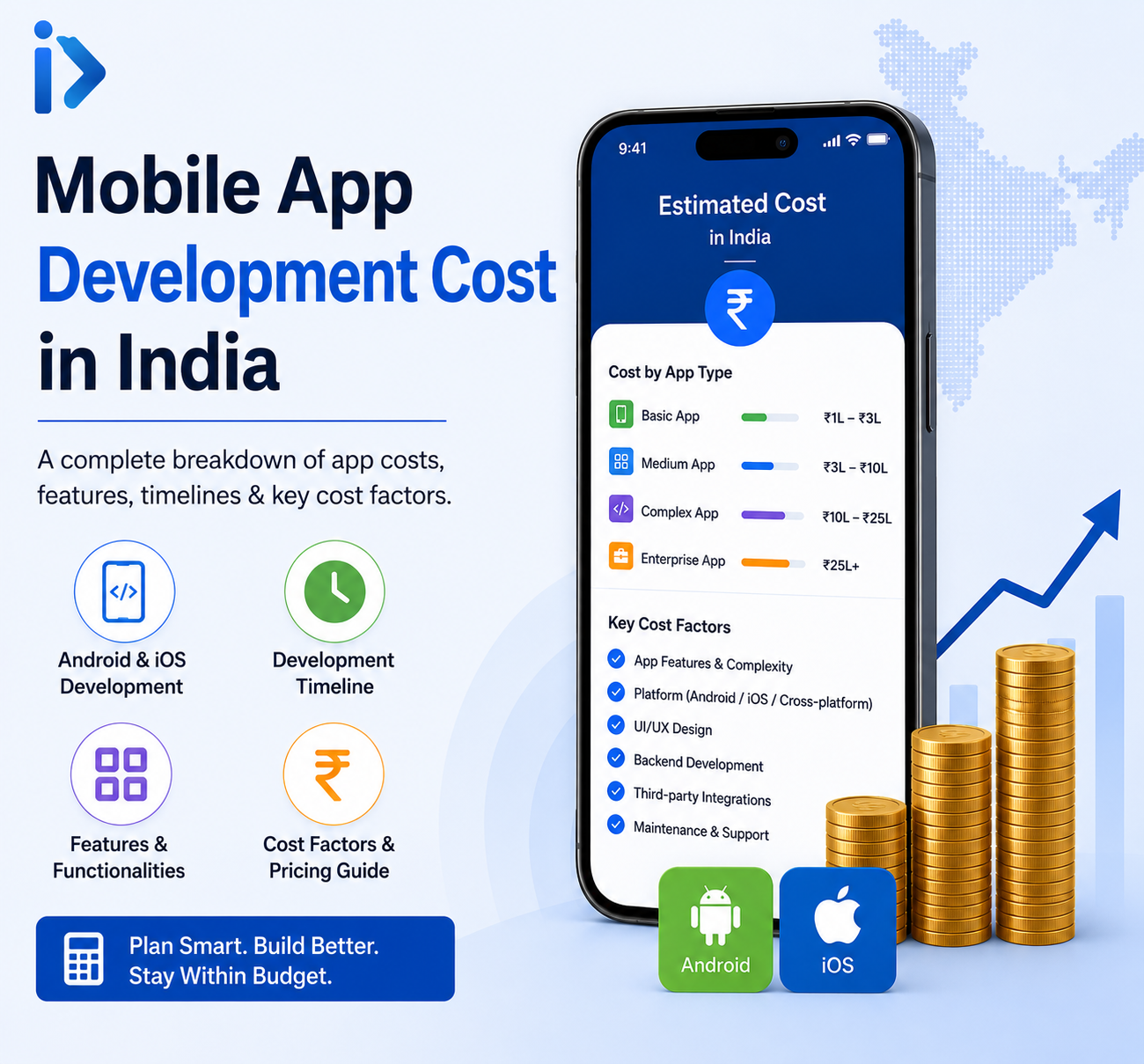
Building a mobile app in India could cost roughly ₹2 lakh to ₹50 lakh, and even beyond that, depending on how big the project is and how complex it gets. The mobile app development cost in India varies because a simple MVP, a booking app, and an enterprise platform require very different levels of design, development, testing, and infrastructure.
Features, UI/UX design, backend needs, integrations, security, platform choice, and the general dev approach can all swing the final quote. So, a native Android or iOS app might end up with a totally different budget than a cross-platform product. Implixo handles mobile apps that are native and also cross-platform for Android and iOS, and technical requirements and business goals.
Mobile App Development Cost in India at a Glance
The mobile app making cost in Indiadepends on the size of the product that’s being planned. A basic MVP usually covers a smaller set of screens and some core functions, while a mid-level application might need user accounts, payment features, dashboards, or even third-party integrations. For more complex apps, you might see real-time communication happening, multiple user roles involved, and backend systems that are more robust, plus high-volume data processing going on in the background. Meanwhile, enterprise-level applications tend to come with heavier customization, tighter security control, and infrastructure built for a large number of users.
The table below gives indicative 2026 budget ranges based on typical project scope. Actual quotes can vary by features, technology, team structure, and development requirements.
App category
Indicative development range
Typical complexity
Basic/MVP
₹2–6 lakh
Low
Mid-level app
₹6–15 lakh
Moderate
Complex app
₹15–50 lakh+
High
Enterprise-grade app
₹50 lakh+
Very high
What These Cost Ranges Usually Cover
A standard mobile app development company quote typically covers the full scope of work needed to push an idea from early planning all the way to being live. In planning, you define the features, the user flow, and the technical requirements, more or less like a roadmap. UI/UX then deals with the overall appearance and the feel, as well as the usability, so people can actually navigate it without friction.
After the design is accepted, app development turns that blueprint into a real, functioning product, whereas backend development covers databases, user sign-in, server-side routines, and the other behind-the-scenes processes that keep things moving. API integrations, meanwhile, link the app to outside services like payment gateways, map providers, or messaging platforms. Prior to release, testing is used to surface bugs and compatibility issues, then deployment handles getting the app ready for publishing to the required platforms.
What Determines the Cost of Mobile App Development?
The mobile app development cost in India depends on what work it takes to turn an app idea into a functional product. The number of features matters, but it is not the only way to judge effort. Things like data handling, the business rules behind it, third-party services, and security requirements all add extra time and deeper technical work. Also, how the different pieces of the app talk to each other can quietly raise the workload. If you understand these cost triggers, it gets easier to see whether a development estimate lines up with the true project scope.
App Complexity and Feature Requirements
A mobile app with simple screens and forms tends to take less build effort than an app that has to manage payments, track user activity, or deal with real-time data. In many cases, user accounts involve registration, authentication, password recovery, plus profile management too. Then there are the dashboards, where data processing happens, and you end up with different screens depending on who’s viewing them. And for payment features, you need secure transaction handling and also payment gateway integration.
The complexity goes up even more once an app includes real-time features, several user roles, more involved processing, or AI/ML functionality. For instance, a delivery app might require live location tracking for customers, drivers, and administrators, and each person sees slightly different information, like a different map or status. So you cannot estimate the development cost just by counting screens, or by thinking in simple layout terms. The business logic underneath, the data flow, all the integrations, and the processing needs can easily end up being way more effort than a bigger app that mainly has fixed, static screens.
Development Platform
The platform you pick can change themobile app cost in India quite a lot, more than people expect. If you build just for Android, the first scope stays more or less contained to one operating system, while an iOS app comes with its own way of developing and testing, not to mention the usual extra checks. But if a company wants both, the team might need to factor in little differences in device behavior, screen sizes, operating systems, and platform-specific features.
There is also the possibility of building cross-platform apps with tools like Flutter or React Native. Having one shared codebase can cut down on duplicate effort when the very same app has to run on Android and iOS. Still, this strategy isn’t always the correct match for every project, and you might end up rethinking the plan. Some apps that depend on particular device capabilities, or that really need platform-specific speed, may still require additional native work. That extra development can change the final budget in practice, sometimes more than expected.
UI/UX Design
The design work can take up a noticeable part of an app budget, especially when the interface has to be built from scratch. A basic interface with typical layouts is quicker to design, while a tailor-made interface may need new screens, user journeys, icons, and distinct interaction patterns. Then there’s prototyping, which adds one more stage, where the team can try out how people actually move around the app before development kicks in.
Bigger projects might also need a design system, so that colors, typography, buttons, and other parts stay consistent across many different screens. Animations as well as interactive elements usually bring extra design and development work, even when everything else seems straightforward. Accessibility can affect the whole process too, especially when the app has to include readable text, better color contrast, screen-reader support, and accessible navigational paths.
Backend and Admin Infrastructure
What users see on the screen is only part of an app. Behind that, there could be a database, various APIs, login systems, and other services that move data around and process requests. A small app might need a rather simple arrangement, while a bigger product can bring multiple linked systems, plus more complex server-side work. A reliable mobile app development company in Noida can help businesses choose the right backend architecture based on their app’s requirements, scalability, and performance.
An admin dashboard gives the business control over users, content, orders, or other app activity. The project might also need cloud infrastructure for hosting, storage, backups, and scaling. As the data set grows, more users come in, and the backend processes stack up, the development work starts to get more involved, and it can feel harder to manage.
Third-Party Integrations
Many apps rely on third-party services instead of building every function internally. Payment gateways can handle transactions, while mapping services can provide location search, routes, and live tracking. Some apps also tap into SMS and email services for those alerts, use social login to simplify account access, and analytics tools can help businesses understand how users interact with the product.
For business apps, CRM or ERP integrations can link that app with existing client, sales, or stock systems. Some offerings also tap into AI APIs to power functions like suggestions, conversational support, image processing, or plain text creation. In practice, every integration has to be set up, tried out, and then kept in check, and that whole loop can quietly increase the build workload.
Security and Data Requirements
Security matters more when an app deals with personal, payment, health, or business-related information. In general, authentication controls the way accounts get accessed, while encryption safeguards the data during storage and also when it moves. On top of that, secure APIs and strict access controls help stop unauthorized users from reaching the information they should not see, even if they try a different path.
The needs depend on what the app actually does. A simple utility might only need basic account protection, but a fintech or healthcare app can require stronger safeguards and more industry-specific measures. These extra validations, security testing, and data-handling requirements can push up the overall mobile app development cost in India.
Design and User Experience: Where Cutting Costs Can Backfire
A lot depends on what the app needs visually. A simple MVP may just want a few clean screens, while a bigger product might ask for bespoke layouts, clickable prototypes, subtle animations, and a consistent visual language everywhere inside the app.
The work also covers mapping how people move from one screen to the next, deciding what should live on each page, and preparing the final designs so developers can build it right. If the app has several kinds of users or has tangled workflows, then you may need extra design time before development kicks off.
Cutting design work too far can lead to changes later when users struggle with the interface, or the developers notice some gaps in the original screens. When comparing quotes, look beyond the mobile app making cost in India and check what the design scope includes.
Native vs Cross-Platform Development: Which Affects Cost More?
Android and iOS do not have to be built the exact same way. A business can just craft each version separately, or they can rely on a cross-platform framework. In practice, that decision changes how much coding gets done, how much testing you will need, and also how much work is tied to each platform.
Native App Development
With native development, the Android build and the iOS build are created separately. This usually means more effort when both platforms matter, but it also gives developers more room to work with features that are specific to each operating system. It may work out better when performance, or some device capability, is a big part of the app.
Cross-Platform App Development
Flutter and React Native let developers share quite a lot of code across Android and iOS. This is handy when both releases need to deliver almost the same features. But still, in a few spots you might end up doing separate work because the app may rely on platform-specific things, like certain device behaviors, or system-based functions.
Which Approach Should a Business Choose?
That depends on what the app really requires in daily use. Native development tends to be the better fit when the product leans heavily on features that are unique to Android or iOS. Meanwhile, cross-platform development works well when the same core product, more or less, must run on both ecosystems without managing two fully separate codebases.
How Development Team Choice Changes App Cost
The mobile app cost in India can change a lot, depending on who ends up building the product. A freelancer might charge less, and they can deliver really well for a smaller app with a very clear scope, though sometimes it feels a bit harder to scale. Meanwhile, a mobile app development company in Delhi brings together designers, developers, testers, plus project managers under one team. Choosing an in-house team can give a business better control over the whole development cycle, yet it also pulls in recruitment, salaries, software tools, and a bunch of ongoing costs. So the best option depends on how complex the app is, the timeline, the technical needs, and how much support is required during and after the build.
What Does It Cost to Maintain a Mobile App After Launch?
The cost of mobile app development does not end when an app goes live. After the launch, the app might still require bug fixes, operating system updates, security improvements, performance inspections, and technical support. Cloud services and third-party tools can also contribute to recurring expenses.
The amount of money put into maintenance varies with the app’s overall size, and also with how often it changes. A simple app might only call for updates now and then, but a bigger product with multiple integrations plus lots of active users can end up needing steady technical attention. Fresh capabilities, better speed and stability, as well as compatibility updates, can pile onto the running budget.
How to Reduce Mobile App Development Cost Without Cutting Quality
These practical steps can keep the project focused:
Start with a clearly defined MVP.
Prioritize essential features.
Avoid unnecessary custom functionality in version one.
Finalize requirements before development.
Reuse suitable components.
Consider cross-platform development when technically appropriate.
Develop additional features in planned phases.
What Does Implixo Offer for Mobile App Development?
Implixo does mobile app development, starting at the early planning stage and continuing after launch, so support stays in place. They cover a range of services, including native and cross-platform development, plus design, testing, and ongoing maintenance.
Android, iOS, and Cross-Platform Development
For Android, iOS, and cross-platform development, Implixo makes apps for Android and iOS using both native and cross-platform approaches. Their listed technologies include Flutter and React Native. So businesses get alternatives, depending on what the app needs and which platforms they aim for.
A Defined Development Process
Implixo’s development services cover requirements, design, development, testing, launch, and post-launch support. It begins with understanding the project’s needs, then goes into interface design and building, before the integrations and the testing are taken care of. After it launches, support keeps going, with maintenance and updates along the way.
Experience Across Different App Categories
Implixo’s portfolio is wide, including Biryani By Kilo, DSL English, StarsTell, Siama, covering different types of app needs. In those projects, there are things like payments, real-time functionality, streaming, dashboards, and also educational content, so the portfolio demonstrates experience across different application requirements and contexts.
Post-Launch Support
The work can continue after an app goes live through maintenance, updates, and optimization. These services help address technical issues, maintain compatibility, and improve the application as its requirements develop.
Conclusion
Mobile app development cost in India depends on the app’s scope, its features, which platform it will run on, the backend, the integrations, and long-term requirements. If a business can set a clear MVP and also pin down the project scope properly, then spending can be planned in a more effective way. For companies that are looking at development partners, Implixo provides Android, iOS, and cross-platform development, plus there is support that goes beyond the very first launch, not just right at the start.
Implixo delivered our travel app with excellent coordination and a smooth user experience. Their team was responsive, kept us updated throughout, and ensured seamless deployment. They helped turn our travel idea into a quality digital product.
Working with Implixo on our astrology app was a smooth experience. Their team understood our vision, delivered a clean and user-friendly design, and handled development and deployment professionally. Great coordination & responsive support.
Implixo handled our health app with great care and professionalism. Their team delivered a clean, user-friendly design and managed complex features smoothly. The project manager was responsive, while the QA & DevOps teams ensured a smooth release.
Apps Built
0+
App Downloads
0M+
Raised by Clients
$0M+
Years Experience
0+
Get a Free Consultation
TRUSTED BY 200+ BUSINESSES
REPUTATION MATTERS. WE PROTECT IT.
Ready to Improve Your Online Reputation?
Build trust, manage reviews, and protect your brand with proven ORM strategies.


 Digital Transformation
 Mobile App Development
 Custom Software Development
 Artificial Intelligence & AI Automation
 Online Reputation Management
 Search Engine Optimization
 Web App Development
  Mobile App Development
  Android App Development
  iOS App Development
  Flutter App Development
  Grocery Delivery
  Laundry Services
  Home Services
  Taxi Booking